Giant Manta Rays gather at a spot on the Kona Coast, near the Kona airport, in Ho‘ona Bay (Garden Eel Bay). Over 60 giant manta rays are said to be living off the coast of Kona and on crowded nights 20 or more may show up in the bay drawn in by huge lights that attract their food. It is an awesome, overwhelming, and unforgettable experience to snorkel or dive next to these giant creatures.
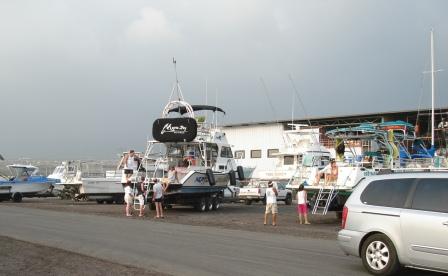
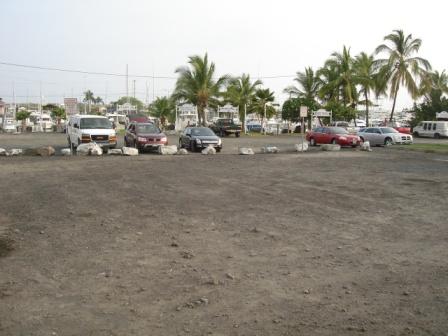
My night snorkeling adventure with the Manta Rays began at the Kona harbor. The harbor has plenty of parking as well as bathrooms. My tour boat was in the parking lot and not yet launched, which surprised me a little since it was a big boat. I signed a release form (which released the tour companry from most everything) in the parking lot and boarded after they launched the boat.
Tour boats from Kona Harbor leave for Ho‘ona Bay in the early evening to be there by dusk. There was no meal served on my tour, just licorice. Other tours have meals and additional time on the boat as a part of their tour package.
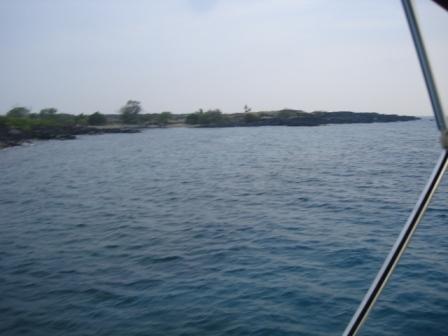
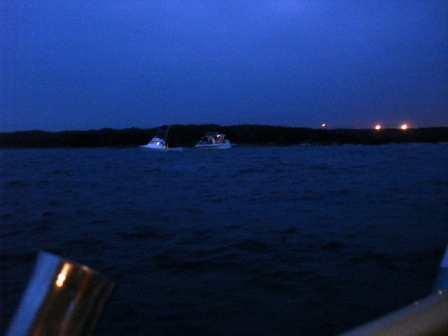
After leaving Kona harbor, darkness settled in quickly. When our boat arrived in the Ho‘ona Bay, five other tour boats were already there.
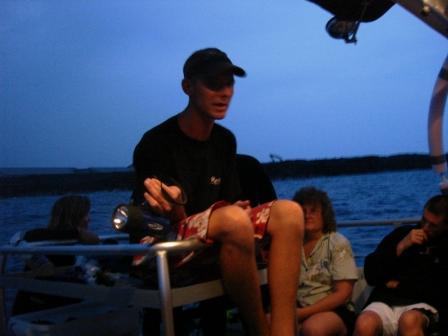
The tour provided snorkeling and scuba equipment or you could bring your own. A guide explained the rules about not touching or disturbing the Manta Rays. They can't guarantee that the Manta Rays will show up. We were lucky that night because a huge number of Manta Rays showed up.
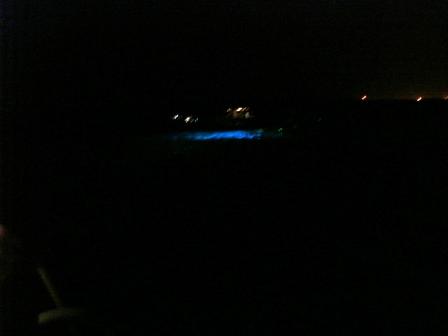
I could see a circle of bright blue where the water was illuminated by lights shinning up from at the bottom of the bay. The tour operators put the lights there to attract marine zooplankton which in turn attracts the Manta Rays. We swam out to the circle of light from the boat. The white lights are other tour boats.
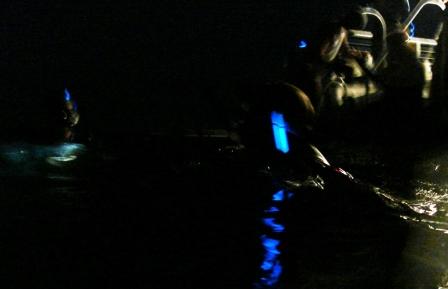
We were given colored identification lights to attach to our snorkel mask. Each tour boat uses a different color so we know which boat to return to. My tour boat's color was blue.
The tour boat provided two styrofoam rings that we could hold on to while watching the fish and manta rays below. Each ring could support about 10 people and it was very helpful to have something to hold on to. Our tour boat was the only one that provided these type of rings.
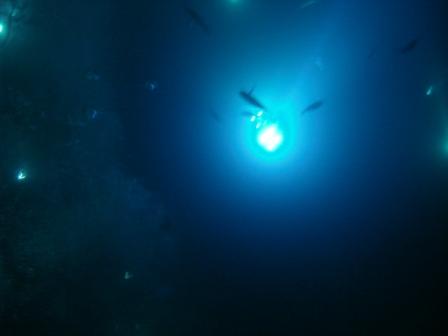
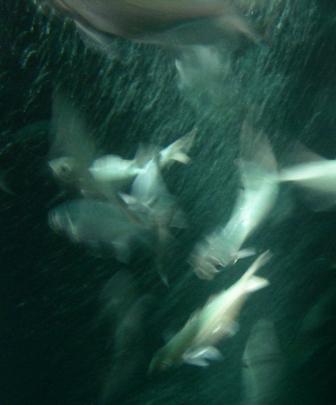
While holding on to the ring I could see the lights in the water directly below me. The lights had already drawn in thousands of fish to feed on the zooplankton.
Scuba divers were led to the bottom of the bay next to the lights to see the view from below. The snorkelers stayed on the top and looked down. The giant manta rays had room to swim and feed between the snorkelers and divers. We were given a handheld bright white light to draw plankton to us and bring the manta rays closer. The light only worked if it was held very steady for a long enough time to attract the plankton. Holding on to the ring made this possible.
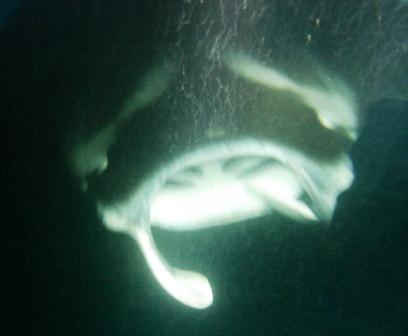
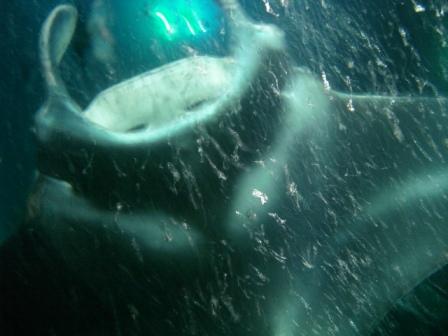
The plankton ultimately drew in the giant Manta Rays. They fed on the plankton by opening their huge mouths to suck it in. The Manta Rays swam toward the light right up to my feet.
I was able to hold the light steady for a minute or so which drew the Manta Rays directly below me. The crowd of snorkelers trying to view the Rays close up pushed me down so that a Manta Ray knocked into me when eating the plankton. It was a jarring clonk to be whacked by a fish the size of a VW bug.
Here are some videos of the adventure.
In this video you can see how close the Manta Rays came and the zooplankton they are feeding on. In the background you can hear the screams from the snorkelers holding on to the ring. And the klunk is when the Manta Ray hit me.
In this video you can see the snorkelers above the Manta Rays. Each boat tour has a different color light. Our color was blue. You can get an idea of what it is like being in the dark in the open ocean.
Some things to consider:
The wet suit the tour provided kept us warm, but some people got overly cold and had to return to the boat early.
The experience can be exhausting. Being in the open ocean at night can be intimidating. The snorkel spot is a distance from the boat, so you have to swim out and then back. Fortunately, our tour boat was the first to leave, but other tours stay for a much longer time.
I don't recommend this outing for small children. Some parents were forced to take their frightened children back to the boats. Even some of the adults were overcome with fear as the huge Manta Rays approached them at high speed with their mouths wide open. Teens seemed to love it. Much of the time there was high pitched screaming from the young and old.
There are many tour companies in Kona that go on night Manta Ray dives and snorkel trips. Make reservations early since tour operators can become fully scheduled and tours are not available every night.